
A Beginner-Friendly Guide to How Modern AI Really Works
Imagine you’re texting your friend.
You type:
“I am going to the…”
Without thinking, your brain already predicts words like:
- school
- office
- market
- park
That’s exactly what ChatGPT does—but instead of using human intuition, it uses mathematics, probabilities, and billions of learned patterns.
In this article, we’ll explore how AI predicts the next word and why it sometimes surprises us with creative responses.
The Biggest Myth About ChatGPT AI
Many people think ChatGPT:
❌ Understands everything like a human
❌ Thinks before answering
❌ Searches the internet for every question
That’s not how it works.
Instead, ChatGPT is essentially a next-token prediction engine.
Every response is generated one token at a time.
Wait… What’s a Token?
Before understanding next-word prediction, we need to understand tokens.
A token is a small piece of text.
For example:
Sentence:
I love artificial intelligence.
Might become:
| Text | Token |
|---|---|
| I | Token 1 |
| love | Token 2 |
| artificial | Token 3 |
| intelligence | Token 4 |
| . | Token 5 |
Sometimes a single word becomes multiple tokens.
Example:
unbelievablemay become
un
believ
able
AI predicts tokens, not necessarily complete words.
Step 1 — Reading Your Prompt
Suppose you ask:
The capital of France isThe AI first converts your sentence into tokens.
The
capital
of
France
isNow it asks itself:
“Based on everything I’ve learned… what token is most likely to come next?”
Step 2 — Looking at Patterns
During training, ChatGPT has seen enormous amounts of text.
Millions of examples like:
The capital of France is Paris.

Paris is the capital city of France.

France's capital is Paris.
Because of this, it learns that after
France isthe token Paris has an extremely high probability.
Step 3 — Probability Calculation
Internally, the AI doesn’t think in words.
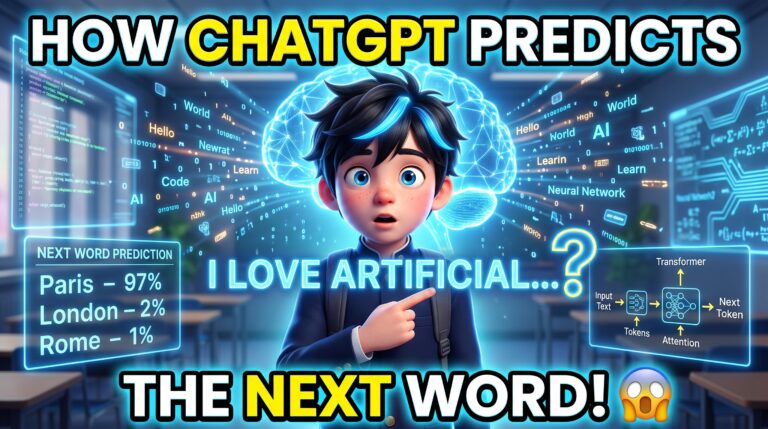
It creates a probability distribution.
Example:
| Next Token | Probability |
|---|---|
| Paris | 97.2% |
| London | 0.9% |
| Berlin | 0.4% |
| Rome | 0.2% |
| Apple | 0.00001% |
It simply chooses one of these probabilities (depending on settings like temperature).
Step 4 — Repeat Again
Now the sentence becomes
The capital of France is ParisThen AI predicts the next token.
Possible probabilities:
| Token | Probability |
|---|---|
| . | 94% |
| and | 3% |
| which | 2% |
It picks one.
Then predicts again.
Again.
Again.
This repeats until the answer is complete.
It’s Like Smartphone Autocomplete…
Your phone predicts:
Happy Birthday↓
to↓
you↓
!ChatGPT works similarly…
…but with billions of parameters and much more context.
Why Doesn’t ChatGPT Always Pick the Highest Probability?
Good question.
Imagine always choosing the most probable word.
Conversation becomes boring.
Example:
Tell me a story.Every AI would generate nearly the same story.
Instead, AI sometimes chooses from several highly probable words.
Example:
| Word | Probability |
|---|---|
| walked | 38% |
| ran | 30% |
| jumped | 15% |
| smiled | 10% |
Choosing different options makes responses feel more natural and creative.
This behavior is controlled by a setting called temperature.
What Happens Inside the AI?
This is where the magic happens.
Modern AI models like ChatGPT use a neural network architecture called the Transformer.
The process looks like this:
Your Prompt
      │
      ▼
Convert into Tokens
      │
      ▼
Token Embeddings
      │
      ▼
Transformer Layers
      │
      ▼
Attention Mechanism
      │
      ▼
Probability Distribution
      │
      ▼
Select Next Token
      │
      ▼
Append Token
      │
      ▼
Repeat Until Complete
This entire process happens in milliseconds.
What Is Attention?
Suppose you ask:
The dog chased the cat because it was scared.
What does it refer to?
The dog?
Or the cat?
The attention mechanism helps the AI look back at previous words and determine that “it” most likely refers to the cat in this context.
Instead of treating every word equally, attention lets the model focus on the most relevant parts of the sentence.
This is one of the biggest reasons modern AI understands context so well.
How Did ChatGPT Learn All This?
During training, the model repeatedly played a simple game:
Hide one token.
Guess the missing token.
Example:
The sky is _____Correct answer:
blueThe AI guessed.
If wrong…
It adjusted billions of internal weights slightly.
It repeated this process trillions of times across vast amounts of text.
Over time, it became extremely good at predicting what usually comes next.
Why Can AI Write Code?
Programming languages are also patterns.
For example:
for(is frequently followed bylet i = 0;Similarly,
function greet(name)is often followed by
{The model learns these common structures during training, allowing it to generate syntactically correct code and even explain it.
Why Does AI Sometimes Make Mistakes?
Even though AI is powerful, it’s still predicting likely tokens.
If it has incomplete information, ambiguous prompts, or lacks sufficient knowledge, it may generate a response that sounds confident but is incorrect. This phenomenon is often called an AI hallucination.
Providing clear prompts and verifying important information helps reduce these errors.
Does ChatGPT Think Like Humans?
Not exactly.
Humans:
- Use memories and experiences
- Understand emotions
- Reason consciously
- Form intentions
ChatGPT:
- Processes tokens
- Calculates probabilities
- Uses learned statistical patterns
- Predicts the next token repeatedly
The results can appear intelligent, but the underlying mechanism is fundamentally different.
Final Thoughts
At its core, ChatGPT doesn’t “know” the next word—it predicts the most appropriate next token based on everything it learned during training and the context you’ve provided.
Every sentence it generates is built one token at a time, using probabilities refined across billions of examples.
That simple idea—predicting the next token again and again—is the foundation behind today’s most advanced AI assistants, coding tools, and conversational models.
Key Takeaways
- ✅ ChatGPT predicts tokens, not entire sentences.
- ✅ It chooses the next token using probability.
- ✅ It repeats this process until the response is complete.
- ✅ Transformers and attention help it understand context.
- ✅ Temperature controls how creative or predictable responses are.
- ✅ AI doesn’t think like humans—it predicts patterns learned from data.
Frequently Asked Questions (FAQ)
Does ChatGPT predict words or letters?
It predicts tokens, which may be whole words, parts of words, punctuation, or special symbols.
Why does ChatGPT sometimes give different answers to the same question?
Randomness (temperature), context, and sampling strategies can lead to different but valid responses.
Can ChatGPT predict the future?
No. It predicts the next token in a response, not future events.
Is next-word prediction enough to create intelligent behavior?
Surprisingly, yes. Combined with massive training data, transformer architectures, and attention mechanisms, repeated next-token prediction can produce reasoning-like, conversational behavior.