
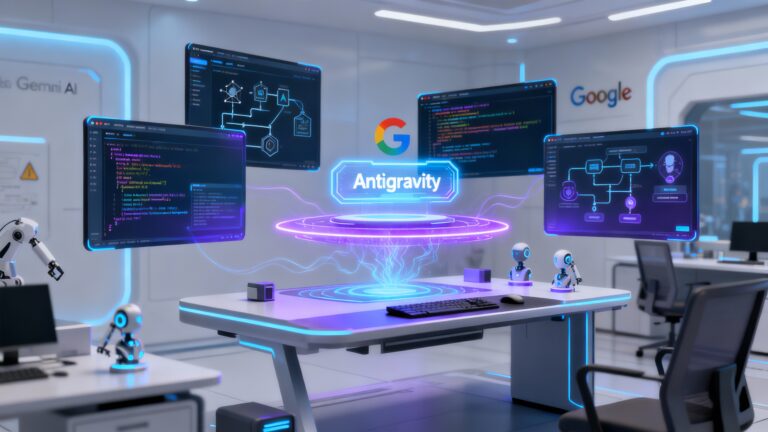

When Google names a product “Google Antigravity IDE,” it’s bound to spark curiosity. Is it a physics breakthrough? A gravity-defying device? A leap into sci-fi engineering?
Let’s clear this up right away:
Google Antigravity is not a physical antigravity technology.
It is a groundbreaking AI-assisted development platform designed to transform how software is built.
This new environment blends the familiar feel of an IDE with the power of autonomous AI agents capable of planning, executing, and verifying complex software tasks. With Antigravity, Google aims to redefine what development looks like in the era of highly capable AI.
Released in public preview and available free of charge, Antigravity marks one of Google’s most ambitious steps toward true agent-first software development.
🚀 What Is Google Antigravity?
Google Antigravity is an agentic development platform built around Gemini 3, Google’s most advanced model for coding and reasoning.
Unlike traditional IDEs that simply embed AI into the editor, Antigravity flips the paradigm:
👉 Agents aren’t inside the IDE — the IDE is inside the agent.
Antigravity provides:
- A state-of-the-art IDE with AI-assisted editing
- A Terminal AI agents can operate
- Browser control for UI testing and research
- A Manager view for orchestrating multiple agents
- A rich system for generating and reviewing Artifacts
- Asynchronous and synchronous collaboration patterns
The result is a platform where agents can autonomously plan, research, write code, launch environments, test features, verify results, and iterate—all while keeping the developer in full control.
Antigravity is designed for a future where development becomes:
- Agent-driven
- Asynchronous
- Autonomous
- Deeply collaborative
🌌 Why Google Built Antigravity
Google describes Antigravity as the “home base for software development in the era of agents.”
The core motivation is clear:
Developers shouldn’t have to micromanage AI.
As models like Gemini 3 gain the ability to operate across multiple surfaces—editor, terminal, and browser—they need a form factor that supports autonomy, long-running tasks, and smooth collaboration.
Antigravity is Google’s answer to:
- Higher-level interactions
- Autonomous agent workflows
- Multi-surface operations
- Real-time validation
- Persistent learning
- Seamless handoff between human and agent
Google wants anyone—from beginners with an idea to experienced engineers—to “experience liftoff” and build faster and more effectively than ever before.
🧩 Core Tenets of the Antigravity Platform
Google Antigravity is structured around four foundational principles:
1. Trust
To trust AI agents, developers need visibility—but not noise.
Most tools today either:
- Overwhelm developers with low-level tool call logs, or
- Hide too much behind polished outputs
Both extremes break trust.
Antigravity solves this by introducing Artifacts, meaningful deliverables that show the agent’s reasoning, planning, and verification steps.
Agents produce Artifacts such as:
- Task lists
- Implementation plans
- Research summaries
- Walkthroughs
- Screenshots
- Browser recordings
These give developers a high-level view of progress without drowning them in technical clutter.
2. Autonomy
Antigravity supports two complementary modes:
A. Editor View (Synchronous Work)
A familiar IDE experience with:
- Smart AI Tab completions
- In-line Commands
- Auto-suggestions
- A side-panel AI assistant
Perfect for hands-on development.
B. Manager View (Asynchronous Work)
A mission-control-style interface where:
- You spawn multiple agents
- Each agent can work in its own workspace
- You observe progress via an inbox-like feed
- Agents operate browser, terminal, and editor autonomously
- You switch instantly between Editor and Manager
This is the future of agent-driven development:
AI operates independently, while you review, approve, or redirect as needed.
3. Feedback
AI is powerful, but not perfect.
Antigravity embraces iteration and provides intuitive feedback loops:
- Google Docs–style comments on text Artifacts
- Click-and-comment on screenshots
- Inline suggestions on plans and drafts
- Direct agent corrections without stopping its workflow
Feedback is treated as a first-class input that agents immediately incorporate.
You don’t need to kill the process and re-prompt.
You simply comment—and the agent adapts.
4. Self-Improvement
Antigravity includes a built-in knowledge base that agents can read from and contribute to.
Agents can learn from:
- Code snippets
- Architecture insights
- Past task solutions
- User feedback
- Corrected mistakes
- Successful workflows
This evolves the agent’s behavior over time, increasing efficiency and quality with each task.
Knowledge becomes a reusable asset—not something lost after each prompt.
🧠 What Antigravity Can Do (Real Examples)
With Antigravity, AI agents can autonomously:
- Research new frameworks and summarize findings
- Generate UI components
- Launch localhost servers and test features
- Debug runtime errors
- Write API routes and database queries
- Create onboarding documentation
- Produce workflow diagrams
- Record browser interactions for demos
- Run tests and fix failing cases
- Build entire scaffolds for frontend and backend projects
All with minimal intervention.
This is not a glorified autocomplete system.
It’s AI-as-a-teammate.
🌍 The Antigravity Experience: Two Modes, Infinite Possibilities
✨ Editor Mode
Great for hands-on development.
- Write code with AI support
- Run commands in the terminal
- Ask the agent to fix issues
- Test features in the browser view
Feels like a next-gen IDE.
🚀 Manager Mode
Ideal for multi-agent workflows.
- Spawn agents for background tasks
- Track progress in an inbox
- Monitor task summaries
- Jump between workspaces
- Review generated Artifacts
- Give feedback asynchronously
Feels like leading a team of AI engineers.
📦 Public Preview Features
In the initial release, Google Antigravity offers:
- Free access for individuals
- Support for macOS, Linux, and Windows
- Compatibility with major models:
- Google Gemini 3
- Anthropic Claude Sonnet 4.5
- OpenAI GPT-OSS
- Generous rate limits refreshed every 5 hours
- Multi-agent orchestration
- Full browser + terminal control
- Artifact generation and feedback tools
This makes Antigravity one of the most accessible agentic dev platforms available today.
🎯 Why Developers Should Care
Google Antigravity represents a fundamental shift:
Coding won’t be prompt-by-prompt.
It will be task-by-task.
Agent-by-agent.
Plan → Execute → Verify → Learn — autonomously.
Developers benefit by:
- Saving hours on repetitive work
- Getting high-quality scaffolds and plans
- Receiving accurate debugging assistance
- Running asynchronous long tasks
- Working with agents that learn with you
- Managing multiple development threads simultaneously
Antigravity lifts the “gravity” of development—making building software lighter, faster, and more enjoyable.
🛫 Try Google Antigravity Today
Google believes Antigravity marks the next evolution of software development.
And for developers, there’s never been a better time to experiment with agentic workflows.