
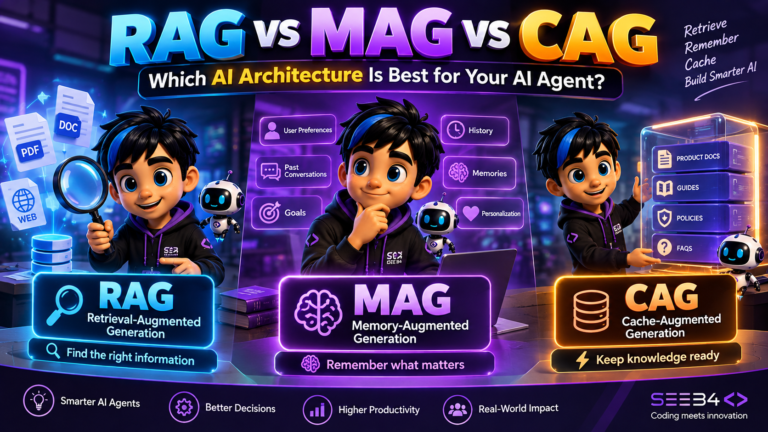

Large Language Models (LLMs) are powerful, but they have one fundamental limitation: they don’t automatically know everything your application knows (RAG,MAG,CAG).
A production AI system may need access to company documents, customer information, previous conversations, product data, databases, or frequently used knowledge.
Three approaches are increasingly important for solving this problem:
- RAG — Retrieval-Augmented Generation
- MAG — Memory-Augmented Generation
- CAG — Cache-Augmented Generation
Although they may sound similar, they solve different problems.
The simplest way to remember them is:
RAG retrieves. MAG remembers. CAG caches.
1. What is RAG?
RAG (Retrieval-Augmented Generation) combines information retrieval with an LLM.
Instead of asking the model to answer using only its trained knowledge, the system first retrieves relevant information from an external knowledge source.
How RAG works
User Question
      ↓
Query Processing
      ↓
Search / Retrieval
      ↓
Relevant Documents
      ↓
LLM
      ↓
Generated Answer
For example, imagine an employee asks:
“How many days of annual leave can I take?”
The AI can search the company’s HR documents, retrieve the relevant policy, and provide an answer based on that information.
Typical RAG components
A production RAG system may contain:
- Document storage
- Document chunking
- Embedding models
- Vector databases
- Keyword search
- Hybrid search
- Reranking
- LLM
- Citation or source tracking
Where RAG works well
RAG is particularly useful when you have:
- Thousands or millions of documents
- Frequently changing information
- Enterprise knowledge bases
- Product documentation
- Customer support data
- Internal company information
- Websites and knowledge portals
Main challenge
RAG depends heavily on retrieval quality.
If the system retrieves the wrong documents, incomplete information, or irrelevant chunks, the LLM may produce a poor answer even if the model itself is highly capable.
2. What is MAG?
MAG (Memory-Augmented Generation) focuses on giving AI systems the ability to maintain useful information across interactions.
While RAG primarily asks:
“What information should I retrieve?”
MAG asks:
“What should I remember?”
This becomes especially important for AI agents and personalized assistants.
Example
A user tells an AI:
“I prefer short technical explanations.”
Several days later, the user asks:
“Explain Kubernetes.”
A memory-enabled AI can use the previous preference and provide a concise explanation.
Memory can potentially contain things such as:
- User preferences
- Previous decisions
- Important conversation facts
- Long-term goals
- Task history
- Agent state
- Project context
Simplified MAG architecture
User Interaction
       ↓
      LLM
       ↓
Memory Extraction
       ↓
Long-Term Memory
       ↓
Future Interaction
When a new request arrives, relevant memories can be retrieved and provided to the model.
Why MAG matters
Traditional chat systems often treat each conversation independently.
Memory changes this model.
Instead of:
Conversation → Answer
you can build:
Conversation
     ↓
Memory
     ↓
Future Conversations
     ↓
Personalized Answers
This makes memory particularly valuable for:
- AI assistants
- Autonomous agents
- Personal productivity tools
- Customer relationship systems
- Long-running workflows
- Personalized tutoring systems
The challenge with memory
Memory isn’t simply about storing everything.
A good memory system needs to determine:
- What should be remembered?
- What should be ignored?
- When should a memory be updated?
- When should conflicting information be resolved?
- When should old information be forgotten?
- Which memories are relevant to the current task?
Poor memory management can actually make an AI system worse.
3. What is CAG?
CAG (Cache-Augmented Generation) takes a different approach.
Instead of retrieving relevant information for every query, a relatively stable knowledge set can be loaded into the model’s available context or cached for reuse.
The basic idea is:
Prepare the knowledge once, reuse it many times.
Traditional RAG
Question
   ↓
Search
   ↓
Retrieve Documents
   ↓
Build Context
   ↓
LLM
CAG
Knowledge Base
      ↓
Preload / Cache
      ↓
Reusable Context
      ↓
LLM
Imagine an application that answers questions about a relatively small product manual.
If the manual is stable and fits within the model’s practical context limits, repeatedly performing retrieval may be unnecessary.
Instead, the knowledge can be prepared and reused.
Benefits of CAG
CAG can provide:
- Lower retrieval complexity
- Faster repeated queries
- More predictable context
- Simpler architecture for small knowledge bases
- Reduced dependence on retrieval pipelines
Where CAG works well
CAG is a good candidate when:
- Knowledge is relatively small
- Knowledge changes infrequently
- The same information is repeatedly queried
- Context can fit within practical model limits
- Retrieval infrastructure would add unnecessary complexity
The limitation
CAG doesn’t magically eliminate context limitations.
If the knowledge base becomes enormous, loading everything into context becomes impractical.
That’s where RAG becomes more attractive.
4. RAG vs MAG vs CAG – AI agents
The biggest difference is their primary purpose.
| Feature | RAG | MAG | CAG |
|---|---|---|---|
| Main idea | Retrieve | Remember | Cache |
| Primary source | External knowledge | Persistent memory | Preloaded knowledge |
| Best for | Large/changing data | Personalization & agents | Small/stable data |
| Retrieval | Usually required | Often used for memories | Often minimized |
| Long-term user memory | Not the main goal | Core capability | Not the main goal |
| Large knowledge base | Excellent | Not its primary purpose | Usually unsuitable |
| Frequently changing data | Excellent | Possible | Less suitable |
| Stable knowledge | Good | Not primary | Excellent candidate |
| Personalization | Limited by itself | Strong | Limited |
| Architecture complexity | Medium–High | Medium–High | Low–Medium |
5. RAG vs MAG: They Are Not Competitors
One common misunderstanding is treating RAG and MAG as alternatives.
In many real-world systems, they complement each other.
For example, an AI assistant might need:
RAG
“What is our company’s refund policy?”
MAG
“What communication style does this user prefer?”
The system can combine both.
                    User Question
                         ↓
              ┌──────────┴──────────┐
              ↓                     ↓
         RAG Retrieval         Memory Retrieval
              ↓                     ↓
       Company Knowledge       User Preferences
              └──────────┬──────────┘
                         ↓
                        LLM
                         ↓
                  Personalized Answer
This is much closer to how sophisticated AI assistants can be designed.
6. CAG vs RAG
The choice between CAG and RAG largely depends on knowledge size and stability.
Choose CAG when:
Small Knowledge Base
        +
Stable Information
        +
Repeated Questions
        ↓
       CAG
Choose RAG when:
Large Knowledge Base
        +
Frequently Changing Data
        +
Need Selective Retrieval
        ↓
       RAG
For example:
A 50-page product guide that rarely changes may be suitable for a cached-context approach.
A company with millions of documents probably needs retrieval.
7. Combining RAG + MAG + CAG
The most interesting architecture isn’t necessarily choosing one.
You can combine all three.
                       ┌──────────────┐
                       │     User     │
                       └──────┬───────┘
                              ↓
                       ┌──────────────┐
                       │ AI Agent/LLM │
                       └──────┬───────┘
                              │
             ┌────────────────┼────────────────┐
             ↓                ↓                ↓
          RAG               MAG               CAG
             ↓                ↓                ↓
      Live Knowledge      User Memory      Stable Context
      Documents           Preferences      Cached Data
      Databases           History          Frequently Used Info
             └────────────────┼────────────────┘
                              ↓
                       Final Response
Each component has a different responsibility.
RAG
“Find the information.”
MAG
“Remember the important information.”
CAG
“Keep frequently used information ready.”
8. A Practical Example: AI Customer Support Agent
Imagine building an AI customer support agent.
The agent needs to answer:
“Why was my order delayed?”
RAG
Retrieves:
- Order information
- Shipping status
- Delivery policies
- Relevant support documentation
MAG
Remembers:
- Customer preferences
- Previous support conversations
- Previously reported issues
- Important customer context
CAG
Keeps frequently used information available:
- Common support procedures
- Product information
- Standard response guidelines
- Stable company policies
The final architecture could look like:
Customer
   ↓
AI Support Agent
   │
   ├── RAG → Current order & company knowledge
   │
   ├── MAG → Customer history & preferences
   │
   └── CAG → Frequently used stable information
   │
   ↓
Personalized Response
This is significantly more powerful than simply connecting an LLM to a vector database.
9. How to Choose?
A simple decision framework is:
Ask three questions.
1. Do I need to find information from a large or changing knowledge base?
→ Use RAG
2. Does the AI need to remember information across interactions?
→ Use MAG
3. Do I repeatedly use a relatively small and stable knowledge set?
→ Consider CAG
And if the answer to multiple questions is “yes,” combine them.
10. The Bigger Picture
The evolution of AI applications can be viewed as a move from simply generating text toward building systems with access to knowledge, memory, and state.
             LLM
              │
              ↓
        External Knowledge
              │
             RAG
              │
              ↓
           Memory
              │
             MAG
              │
              ↓
       Cached Context
              │
             CAG
              │
              ↓
        Intelligent Agent
The LLM remains the reasoning and generation engine, while these surrounding systems provide the information it needs.
Conclusion
RAG, MAG, and CAG solve three different problems:
RAG = Retrieve knowledge when you need it.
MAG = Remember information across interactions.
CAG = Keep reusable knowledge readily available.
There isn’t a universal winner.
For large, dynamic knowledge bases, RAG is usually the natural choice.
For personalized and long-running AI agents, MAG becomes increasingly important.
For small and stable knowledge bases that are queried repeatedly, CAG can offer a simpler and potentially faster architecture.
And for sophisticated production AI systems, the future may not be RAG vs MAG vs CAG at all.
It may be:
RAG + MAG + CAG + Agents = AI systems that can retrieve, remember, and act.