
As AI adoption grows, developers face a critical question:
👉 Should you use RAG (Retrieval-Augmented Generation) or Fine-Tuning?
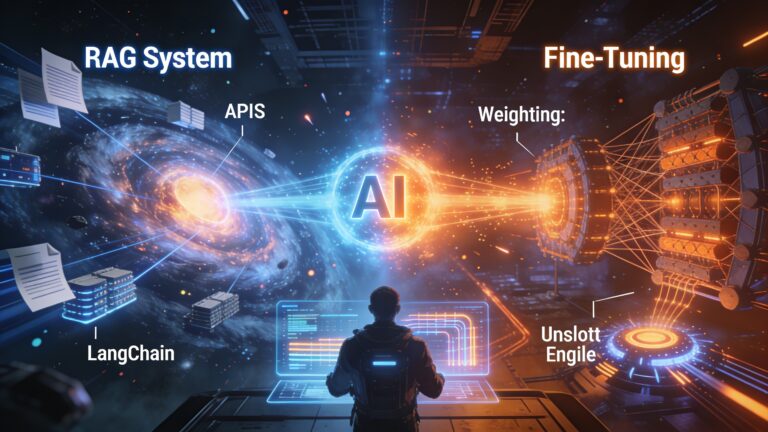
Both approaches enhance AI models—but they work in completely different ways. In this guide, we’ll break down RAG vs Fine-Tuning, including tools like LangChain and Unsloth, their differences, use cases, pros & cons, and when to choose each.
🧠 What is RAG (Retrieval-Augmented Generation)?
RAG is a technique where an AI model retrieves relevant data from external sources before generating a response.
📌 How RAG Works
- User asks a question
- Query is converted into embeddings
- Search happens in a vector database
- Relevant documents are retrieved
- AI generates answer using that context
⚙️ Key Components of RAG
- Embeddings model
- Vector database (FAISS, Pinecone)
- Retriever
- LLM (GPT, Claude, Qwen, etc.)
🔧 Tools for RAG
1. LangChain
A popular framework to build RAG pipelines and AI applications.
👉 Reference: https://python.langchain.com/docs/
2. LlamaIndex
Helps connect LLMs with structured and unstructured data.
👉 Reference: https://www.llamaindex.ai/
3. Pinecone
Managed vector database for fast similarity search.
👉 Reference: https://www.pinecone.io/
4. FAISS
Efficient similarity search library for embeddings.
👉 Reference: https://github.com/facebookresearch/faiss
✅ Advantages of RAG
- No need to retrain models
- Always uses latest data
- Lower cost compared to fine-tuning
- Easy to update knowledge
❌ Limitations of RAG
- Slightly slower (retrieval step)
- Depends on data quality
- Requires vector DB setup
🧪 What is Fine-Tuning?
Fine-tuning means training an existing AI model on your custom dataset to specialize it.
📌 How Fine-Tuning Works
- Prepare dataset
- Train model on new data
- Adjust model weights
- Deploy trained model
🔧 Tools for Fine-Tuning
1. Unsloth
A fast and efficient framework for fine-tuning LLMs with minimal GPU usage.
👉 Reference: https://github.com/unslothai/unsloth
2. Hugging Face Transformers
Industry-standard library for training and fine-tuning models.
👉 Reference: https://huggingface.co/docs/transformers
3. PyTorch
Used for building and training neural networks.
👉 Reference: https://pytorch.org/
4. DeepSpeed
Optimizes large-scale model training.
👉 Reference: https://www.deepspeed.ai/
✅ Advantages of Fine-Tuning
- Better accuracy for specific tasks
- Faster inference (no retrieval step)
- Strong domain expertise
- Custom behavior
❌ Limitations of Fine-Tuning
- Expensive training cost
- Requires ML expertise
- Hard to update data
- Risk of overfitting
⚔️ RAG vs Fine-Tuning (Key Differences)
| Feature | RAG | Fine-Tuning |
|---|---|---|
| Data Source | External (documents) | Internal (trained data) |
| Cost | Low | High |
| Updates | Easy | Hard |
| Speed | Medium | Fast |
| Accuracy | Context-dependent | High (domain-specific) |
| Setup | Moderate | Complex |
🎯 When to Use RAG?
Use RAG if:
- You have dynamic or frequently changing data
- You want quick setup
- You need document-based AI (PDF, DB, APIs)
- You prefer low cost
👉 Example:
- Company knowledge chatbot
- AI search engine
- Documentation assistant
🎯 When to Use Fine-Tuning?
Use Fine-Tuning if:
- You need high accuracy for specific tasks
- Your data is stable
- You want custom behavior
- You have training resources
👉 Example:
- Medical AI
- Legal AI
- Code generation model
🚀 RAG + Fine-Tuning (Best of Both Worlds)
Modern AI systems combine both approaches:
- Use Unsloth / Hugging Face → for fine-tuning behavior
- Use LangChain / LlamaIndex → for dynamic knowledge retrieval
👉 Benefits:
- High accuracy
- Updated knowledge
- Better performance
💡 Real-World Example
🏢 Company Chatbot
- Use RAG (LangChain) → fetch latest company documents
- Use Fine-Tuning (Unsloth) → improve response quality & tone
🔥 Final Thoughts
Both RAG and Fine-Tuning are powerful—but they solve different problems.
👉 Choose RAG for flexibility and real-time data
👉 Choose Fine-Tuning for precision and specialization
💡 In 2026, the most advanced AI systems use both together.